Pinocchio Fights His Classmates and Is Taken Away by the Police
Pinocchio (Tania Zamorsky Edition)Pinocchio Fights His Classmates and Is Taken Away by the Police is a turning point in which Pinocchio’s susceptibility to his schoolmates’ influence leads from a skipped lesson to a dangerous fight, an apparent fatal injury, and flight from the Carabinieri. The episode is driven by a cruel prank, but its consequences are real: a schoolbook becomes a weapon, Pinocchio’s attempt to help is overshadowed by suspicion, and he runs rather than remain in the authorities’ custody.
Background and the Shark Prank
The incident follows Pinocchio’s promise to study and work so that he can become a real boy. The next day he goes to the communal school, where the other boys ridicule him for being a puppet. They tug at his clothes and cap, draw moustaches beneath his nose with ink, and try to make him dance by tying strings to his limbs. The schoolyard has already made him an object of mischief before the later trick draws him away from his lessons.
A warning about his companions has also gone unheeded. Pinocchio’s schoolmates, he has been cautioned, may turn him against study and bring him into serious trouble. He brushes off the concern with a self-assured gesture, tapping his forehead as if to display his good sense. When a group of boys later approaches him on his way to school with supposed news, he is ready to follow them: a Great Shark, they claim, has arrived in the nearby sea, as large as a mountain. Pinocchio wonders whether it is the same one that drowned his father, Geppetto. The boys say they are going to the shore to see it and invite him along.
From School to the Shore
Pinocchio asks how long the journey will take. Told they can go and return within an hour, he urges the group to race. The boys run across the fields with their books and notebooks under their arms, and Pinocchio leads them, moving so quickly that he seems to have wings at his feet. He turns to mock the others when they fall behind, laughing at their panting, dusty progress. The narrator foreshadows the trouble ahead even as Pinocchio treats the excursion as a contest.
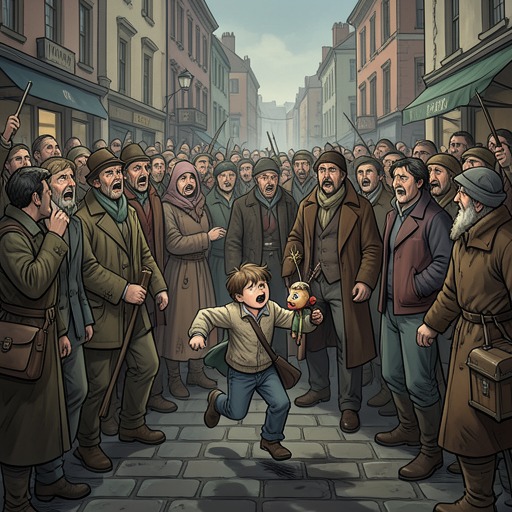
At the shore, the classmates’ answers to his questions are incoherent and accompanied by foolish laughter. Pinocchio realizes that they have deceived him: there is no truth in their story about the Great Shark. He takes the trick as an insult and demands to know what amusement they found in it. The prank thus changes the boys’ relation from companions on an outing to antagonists. Their mockery gives way to a confrontation over pride, with the eldest warning Pinocchio that he is alone and they are seven.
The Fight and Eugenio’s Injury
Pinocchio answers their threat with a joke comparing their number to the seven deadly sins. The boys take the remark as a collective insult. One of the boldest strikes him on the head, and Pinocchio immediately hits back. The quarrel becomes a general, fierce fight. Although alone, he holds his ground with his hard wooden feet, keeping the boys at a distance and bruising those they reach.
Unable to match him in close combat, the boys turn their schoolbooks into missiles. They throw primers, grammars, readers, and other volumes at Pinocchio, who dodges them; the books fly past him and fall into the sea. Then the boys seize Pinocchio’s bundle of books. Among them is a particularly heavy treatise on arithmetic, bound in thick board and parchment. One boy hurls it at Pinocchio’s head, but misses and strikes Eugenio, a classmate. Eugenio turns pale, cries out that he is dying, and falls onto the shore’s sand. The intended target escapes the blow, but the fight’s danger is made unmistakable by the injury to someone who was not its intended victim.
Aid, Suspicion, and Flight
The sight of Eugenio lying motionless frightens the other boys into running away. Pinocchio stays. Though himself shaken and in pain, he wets his handkerchief in seawater and applies it to Eugenio’s temple. He weeps, calls to his companion, and despairs over what will happen when he returns home. In his distress, he recognizes the chain of disobedience that brought him there: he should have gone to school, and both his teacher and his mother had warned him against bad companions. His remorse does not undo the injury, but it distinguishes his conduct after the fight from the group’s flight.
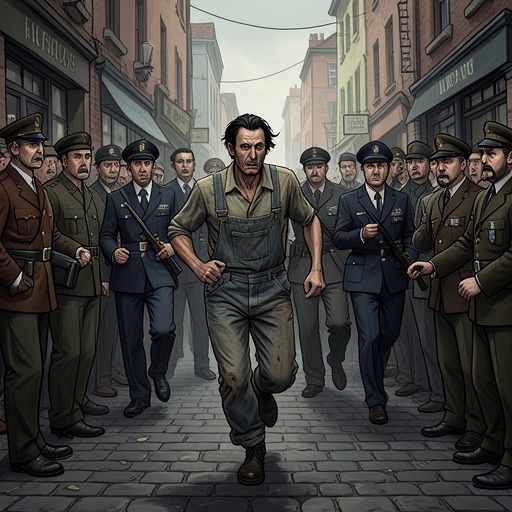
Two Carabinieri arrive and ask what Pinocchio is doing on the ground. He explains that he is attending to his schoolmate. They ask whose book it is, and Pinocchio says it belongs to him. The officers then order him to get up and come with them, without waiting for him to explain further. Before taking Pinocchio away, they call over fishermen passing in a boat and entrust Eugenio to their care, asking them to take the injured boy home and look after him; they say they will return the next day to check on him. The practical care arranged for Eugenio contrasts with the abrupt order imposed on Pinocchio.
Pinocchio asks permission to retrieve his cap. The Carabinieri allow it, provided he is quick. He picks it up but puts it between his teeth rather than on his head, then bolts toward the shore at full speed. The officers send a large mastiff after him, and Pinocchio runs while the dog gains on him. People crowd the windows and street to watch, but a cloud of dust soon hides both pursuer and pursued. The episode ends not with Pinocchio’s return to school or a resolution of Eugenio’s condition, but with a flight that extends the consequences of his choice of companions into a new pursuit.
Narrative Significance
The scene turns the lesson about bad companions into a sequence of visible consequences. The false report takes Pinocchio away from school; a joke escalates into violence; a schoolbook, an instrument of study, becomes the object that injures Eugenio; and the group that provoked the outing abandons the scene when it becomes serious. Pinocchio alone remains to help, yet his ownership of the book makes him the one the Carabinieri take away. His good impulse and his earlier recklessness coexist, rather than cancelling one another.
The ending sharpens that contradiction. Pinocchio has just acknowledged that ignoring advice brought him into trouble, but when the Carabinieri order him to go with them, he chooses escape. His speed, earlier a source of playful superiority in the race across the fields, now carries him into a chase. The reported appearance of the Great Shark proves to be a lie, yet the diversion produces a genuine crisis: injury, fear, suspicion, and flight.